Authorized Associate of Companies, BASF AE, FOSROC INTERNATIONAL Ltd and SINTECNO SA for the implementation of their products based on the European Standard ELOT EN 1504
Inspections and Testing of building structure and construction elements
 To assess the concrete strength in the control of existing buildings, taking cores is often necessary. Cores are used for conducting some indirect methods.
In addition to the compressive strength of concrete by taking cores, we can still examine:
- Generally the quality of the concrete of the construction
 The method of Schmidt Hammer, is a non-destructive method for estimating the strength of concrete, which is based on measuring the surface hardness of the components tested.
 Nail pull out test is an indirect method for determining the compressive strength of the concrete. The nail is inserted in the concrete, after its ejection from a special gun. The nail has a length of 1-4cm and a diameter of 4mm. The nail is extruded from the concrete by using a specific extruder which carries a dynamometer. The force recorded by the dynamometer is associated with the compressive strength of the concrete.
 With this method the reinforcement of concrete can be detected, by using a magnetometer, and it is estimated, to quite an extent, the coating thickness as well as the diameter of the rod.
 The process of the carbonation depth measurement is based on the change of pH of the concrete of a structural element by the presence of carbon dioxide (CO2).
 The purpose of crack measuring gauges placement is to monitor the evolution of the crack and its characterization as active or inactive. Depending on the scope and speed of drilling we recommend any intervention.
 The penetration of chlorides is a process that is done on completely or partially filled pores with water (moisture). The presence of chlorides in the concrete comes from internal factors (admixtures or aggregates from coastal areas, airborne), most of the time. But there are external factors such as the use of snow melting salt on the roads and the penetration of sea salt to ports and coastal structures as the environment is rich in chlorides.
 The determination of alkalinity (PH of the concrete) is carried out with a color indicator of alkalinity (from 0 to 13), according to ASTM standard F710-5. With this test it is possible to record (photographic documentation) of the alkalinity of the concrete in relation to the depth of attack.
 The checks are carried out with simultaneous analytical recording, characterization and photographic documentation, as well as with their accurately print on an electronic analytical plan.
Structural reinforcement and restoration of existing structures
 Composite materials are placed on the surfaces of the components and constitute a sort of permanent external reinforcement. The connection and cooperation of different materials is achieved by epoxy resins. Their use is now one popular strengthening technique because it is easy to implement.
The fiber reinforced polymers are divided into::
- Fabrics, rods and carbon fiber plates.
- Glass fiber fabric
- Kevlar fabric
The choice of one of these categories depends on the type of support we want to achieve, but also by the environmental conditions during the application.
Uses of composite materials
- Reinforcement of columns by imposing external confinement and increasing ductility.
- Increased shear resistance
- Increase in flexural strength
- Impact Reinforcement
 In cases of reinforcement in flexion or shear rods of reinforced concrete, laminated thick steel sheets from 1mm to 5mm are placed at the bottom pad or at the sidewall of the bar respectively. The sheets shall cooperate with the existing rod with bolts, screws, chemical anchors, epoxy resin or a combination of them by creating a new stronger and stiffer composite section.
 Adding new steel members is an economic and highly efficient method for strengthening reinforced concrete beams and slabs. The obvious advantage is the reduction of the openings, creating new composite sections with greater resistance from the existing ones and the support of active or passive approach.
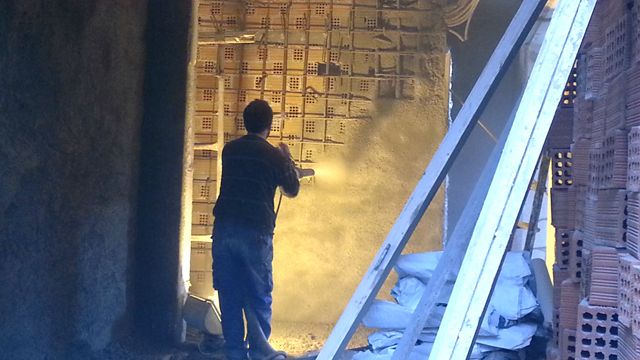 The shotcrete (sprayed concrete or shotcrete or gunite) that is used in reinforcement projects is concrete of fine aggregate gradation which is concreted with blasting. The application requires special equipment and trained staff. In the following four characteristics is due the widespread use in intervention projects:
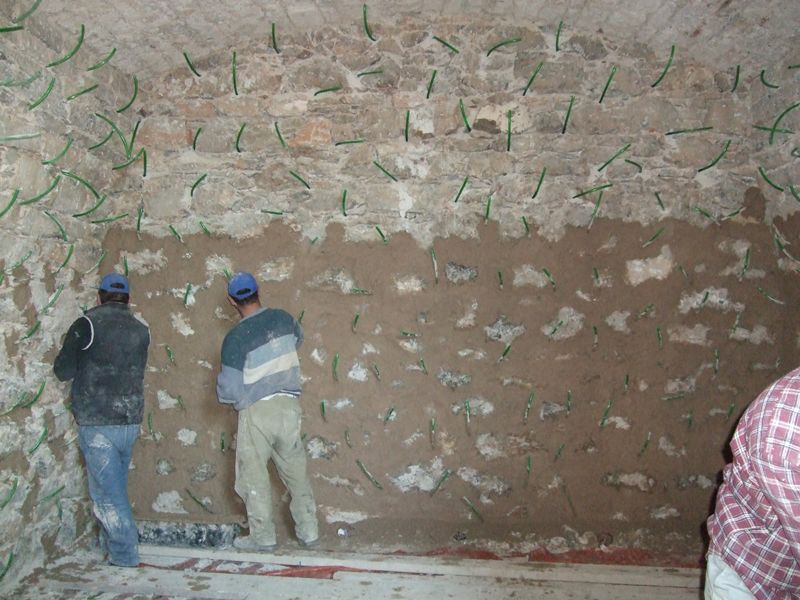 The grouting is used to fill cracks in buildings of masonry and stonework or to improve the mechanical characteristics and sealing of a soil or a rocky formation.
 The use of epoxy resins is highly increased in operations primarily to repair cracks but also other applications. The technique of resin injections is found mainly in bearing construction body made of concrete and masonry. It aims to recover the original bearing capacity of cracked structures as well as their rigidity. Recommended for protection against reinforcement corrosion, the creation of robust connection between concrete parts and for sealing.
 The repair process of a component is designed to restore its initial mechanical characteristics it had before the undergone damages. The proceedings carried out, realize a full restoration of the element section, but also reset its rigidity.
 Our company has in its property the following equipment in order to implement undisturbed cuts in reinforced concrete elements and roadworks.
Specialized Works
 Our company carries out specialized repairs - restoration of of cracked or damaged concrete floors and industrial floors that meet high demands. Their application includes undisturbed cutting and removal of problematic parts, improvement of sub-base, installation of bolts by using resins, placement of new steel reinforcement, concreting, final surface treatment and cutting joints, sealing of joints.
 The company also implements specialized method of stitching to repair major cracks in concrete floors and industrial floors, by using bolts "F" (stitching dogs), epoxy resins and special methacrylates cements of rapid setting and high standards for repairing heavy duty floors.
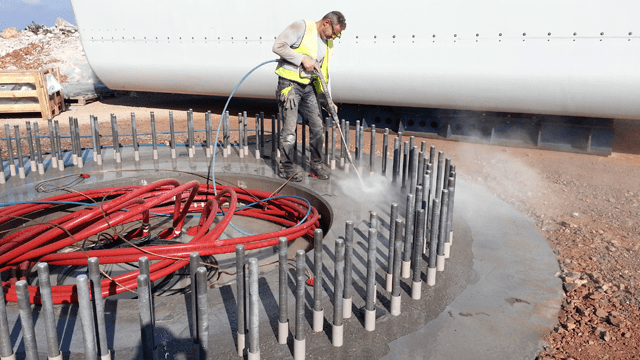
 We offer full services in the field of cleaning wall surfaces and surfaces with rotten paint and dirt by using hydroblast pressing machines of 500bar.
 Integrated installation (Preparation, installation, connection, control of depollution) of cathodic protection systems in existing structures by placing implanted sacrificial anodes or external laminations of sacrificial anodes in accordance with EN12696
 Injection of polyurethane seals to seal constructions through pre-assembled special nozzles (packers) using a specialized pump.